

Alzheimer’s Disease Stages
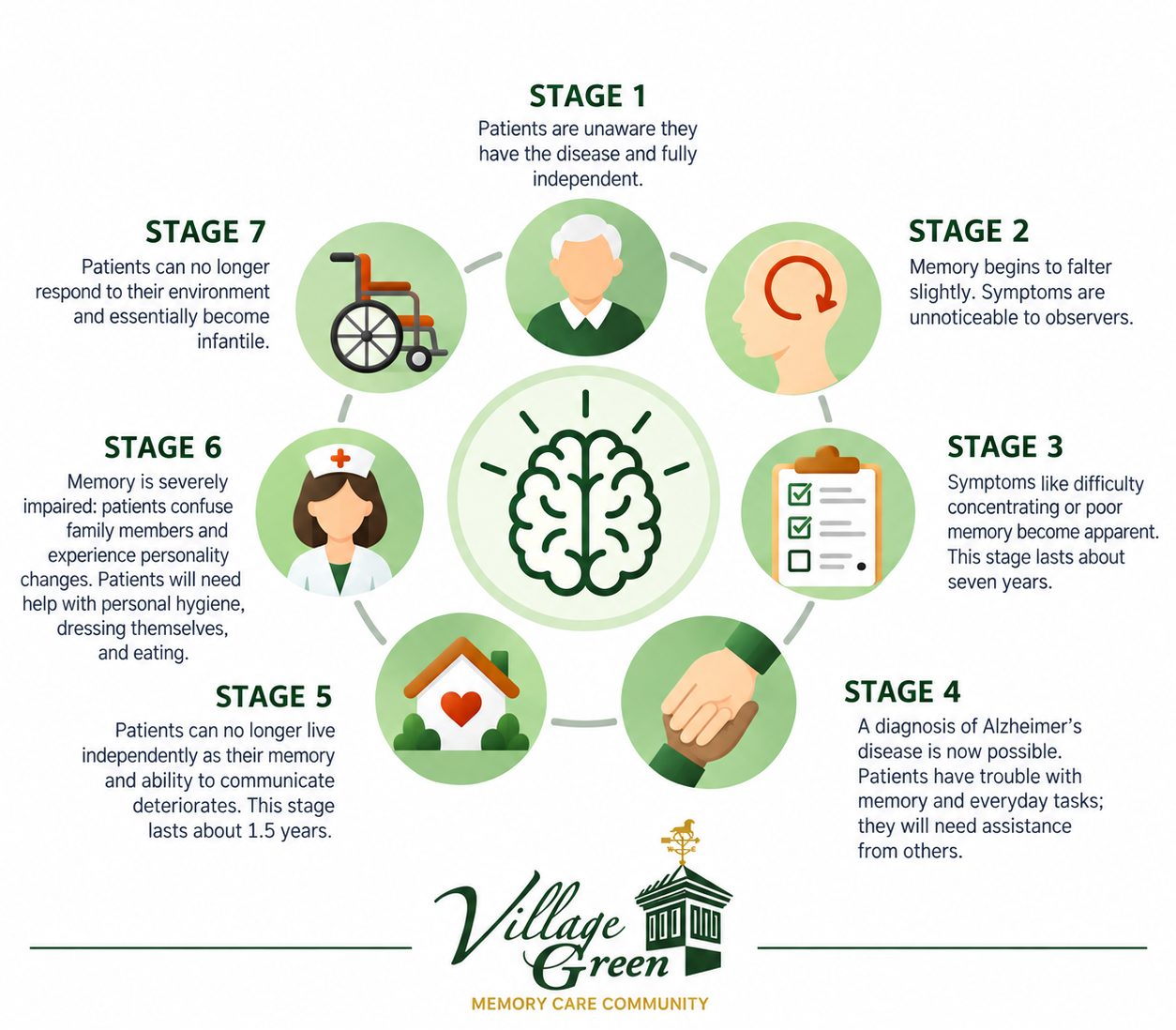
Alzheimer’s disease is a progressive neurological condition that affects memory, thinking, behavior, and the ability to perform everyday activities. Although memory loss is often the first noticeable symptom, the disease can also affect communication, judgment, emotional responses, and physical abilities as it progresses.
Understanding the seven stages of Alzheimer’s disease can help families recognize changes in their loved one’s abilities, anticipate evolving care needs, and make informed decisions about when additional support or specialized memory care may be appropriate.
The seven-stage framework provides a more detailed description of disease progression than the commonly used three-stage classification of mild, moderate, and severe Alzheimer’s. However, symptoms and progression vary considerably between individuals. Not everyone experiences every symptom, and the duration of each stage cannot be predicted precisely.
Stage 1: No Noticeable Cognitive Decline
During Stage 1, individuals show no noticeable symptoms of memory loss or cognitive impairment. They can independently manage their daily routines, maintain relationships, work, drive, and participate in their usual activities without experiencing difficulties attributable to dementia.
However, Alzheimer’s-related changes in the brain may begin long before symptoms become apparent. According to the National Institute on Aging, abnormal changes associated with Alzheimer’s can begin a decade or more before memory problems or other cognitive symptoms emerge.
These early changes may include the accumulation of amyloid plaques and tau tangles, which interfere with communication between nerve cells and contribute to progressive brain damage.
This period is sometimes described as preclinical Alzheimer’s disease. Importantly, the absence of symptoms does not establish that someone has Alzheimer’s, and not everyone with early biological changes will develop dementia.
What families should know: At this stage, there may be no outward signs that additional caregiving or memory care services are necessary. Maintaining regular healthcare appointments and addressing general health concerns can support long-term well-being.
Stage 2: Very Mild Memory Changes
During Stage 2, individuals may begin experiencing occasional memory lapses that resemble ordinary age-related forgetfulness. These changes are often subtle and may not be noticeable to family members, friends, or healthcare professionals.
Common experiences may include forgetting familiar words, misplacing everyday objects, or temporarily struggling to recall names or details from recent conversations.
The person generally remains independent and can continue managing finances, household responsibilities, personal hygiene, and social activities.
An important distinction is that occasional forgetfulness does not necessarily indicate Alzheimer’s disease. Memory changes can have several causes, and mild symptoms alone are insufficient to establish a diagnosis.
Some individuals who are developing Alzheimer’s may notice that memory lapses are becoming more frequent or that tasks previously completed with ease now require additional concentration.
What families should know: If memory changes become persistent, progressively worsen, or begin interfering with familiar activities, arranging a medical evaluation can help identify possible causes.
Stage 3: Mild Cognitive Decline
During Stage 3, memory and thinking difficulties may become more noticeable to close family members, friends, or colleagues. Although the individual can generally continue living independently, everyday responsibilities may begin requiring more time, concentration, or effort.
Some people experience difficulty remembering information they have recently read, recalling names, organizing appointments, or following complex conversations.
Other changes may include:
- Increased difficulty planning activities or managing multiple responsibilities.
- Frequently misplacing important belongings.
- Struggling to find appropriate words during conversations.
- Becoming overwhelmed by demanding work or social situations.
- Having difficulty navigating unfamiliar environments.
For individuals who are still employed, responsibilities involving detailed planning, multitasking, or complex decision-making may become more challenging. Some may choose to reduce their workload or adjust their responsibilities.
These symptoms can be consistent with mild cognitive impairment (MCI), which involves measurable changes in memory or thinking that do not substantially interfere with independent daily living.
However, MCI is not always caused by Alzheimer’s disease, and not everyone with MCI progresses to dementia.
What families should know: This is an appropriate time to discuss future care preferences, organize important legal and financial documents, and establish a plan for monitoring changes in memory and daily functioning.
Stage 4: Moderate Cognitive Decline
During Stage 4, cognitive difficulties become more apparent and begin interfering with certain everyday activities. Individuals may continue living at home and participating in familiar routines, but they may require assistance with more complex responsibilities.
Common difficulties include managing household finances, paying bills, planning meals, organizing medications, and remembering important appointments.
A person may also experience greater difficulty recalling recent events or details from their personal history. Tasks that involve several steps, such as preparing a complicated meal or organizing travel arrangements, may become increasingly challenging.
Changes in mood and behavior can also occur. Some individuals become more withdrawn, frustrated, or anxious when confronted with situations that expose their memory difficulties.
This stage may correspond to mild Alzheimer’s dementia in people whose symptoms are caused by Alzheimer’s disease. A diagnosis can often be made during the mild dementia stage, although evaluation and diagnosis are also possible earlier in the disease process.
What families should know: Families may need to provide more consistent support with financial management, medication routines, transportation, and household safety. A professional assessment can help determine which activities remain safe to perform independently.
Stage 5: Moderately Severe Cognitive Decline
During Stage 5, memory loss and cognitive impairment become more significant, and individuals typically require regular assistance with daily activities.
A person may have difficulty remembering important personal information, such as their current address, telephone number, or details about significant life events. They may also become confused about the date, time, or their current location.
Choosing appropriate clothing, preparing meals, following medication schedules, and navigating unfamiliar environments can become increasingly difficult.
Although individuals may still recognize familiar faces and retain meaningful memories, their ability to make independent decisions and respond appropriately to unexpected situations may decline.
Many people at this stage require substantial daily support, and living alone may no longer be safe without appropriate supervision and assistance.
The middle stage of Alzheimer’s can last for many years, but the length of any individual stage varies. A fixed duration of 1.5 years should not be assumed for every person.
What families should know: Families may wish to explore in-home caregiving, adult day programs, or specialized memory care communities when a loved one requires frequent supervision, assistance with personal care, or support that cannot be reliably provided at home.
Stage 6: Severe Cognitive Decline
During Stage 6, Alzheimer’s disease can significantly affect memory, communication, behavior, and the ability to perform basic daily activities.
Individuals may have difficulty recognizing familiar people or remembering important details about their own lives. Some may confuse family members, struggle to identify their surroundings, or become disoriented even in familiar environments.
Personality and behavioral changes may also become more pronounced. These can include increased anxiety, agitation, suspiciousness, or distress. Some individuals may experience hallucinations or delusions, although these symptoms do not occur in everyone.
As cognitive abilities decline, individuals generally require increasing assistance with personal care, including bathing, dressing, grooming, toileting, and eating.
Changes in sleep patterns, wandering, and difficulties communicating needs can create additional caregiving challenges.
Despite these changes, individuals may continue to respond positively to familiar voices, music, gentle reassurance, and meaningful interactions with loved ones.
What families should know: Around-the-clock supervision and hands-on assistance may become necessary. Specialized memory care services can provide structured routines, personal care support, and an environment designed to accommodate changing cognitive and physical abilities.
Stage 7: Very Severe Cognitive Decline
Stage 7 represents the most advanced phase of Alzheimer’s disease. Individuals experience profound cognitive impairment and become increasingly dependent on others for nearly every aspect of daily care.
Communication abilities may decline substantially. A person who previously spoke in complete sentences may gradually communicate through shorter phrases, individual words, facial expressions, or nonverbal responses.
As the disease progresses, physical abilities can also deteriorate. Individuals may lose the ability to walk independently, sit upright without support, or maintain adequate head control.
Eating and swallowing difficulties may develop, increasing the risk of choking, dehydration, inadequate nutrition, and aspiration-related complications.
People in this stage generally require extensive assistance with eating, bathing, dressing, repositioning, and maintaining personal comfort. Reduced mobility and difficulty swallowing can also increase vulnerability to infections, including pneumonia.
Although verbal communication may become limited, individuals can still benefit from compassionate interaction, familiar music, gentle touch, and reassuring companionship.
The final stage can extend over a considerable period, but its duration varies substantially depending on the individual’s overall health, complications, and disease progression.
What families should know: Care typically focuses on maintaining comfort, dignity, safety, and quality of life. Families may benefit from discussing advanced care planning, palliative care, and hospice services with their loved one’s healthcare team.